


Focus on dementia
 Dementia is an increasingly common reason for long-term care and support for an affected person. In principle, the caregivers we employ have all had experience with dementia patients and know about the particular challenges of dealing with those who are affected by it. With the right attitude and experience, our caregivers have always found good approach to persons with dementia.
Dementia is not a specific illness. Instead, dementia implies a group of symptoms that limit thinking and social skills and disrupt daily functioning. There are many causes and symptoms of dementia. Alzheimer's disease is the most common cause of what is known as progressive dementia. Memory loss usually occurs with dementia. However, memory loss alone does not mean someone has to have dementia. Basically, dementia manifests as problems with at least two functions in the brain, such as memory loss, impaired judgment, problems speaking or problems with everyday activities.
The following behaviors can be a first indications of dementia:
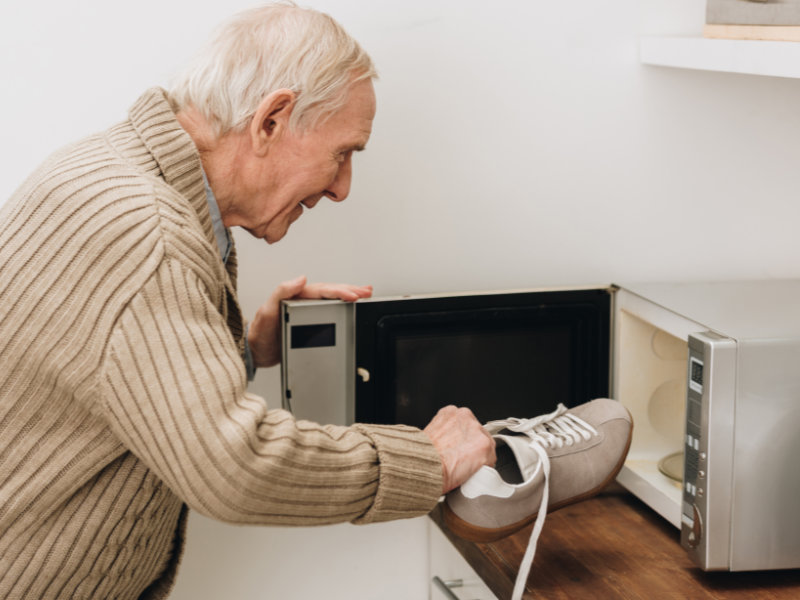
- speech disorders
- forgetting recent events
- misjudgment of dangers
- difficulty performing usual activities
- severe mood swings, persistent anxiety, irritability and suspiciousness
- persistent denial of mistakes or confused behaviour
- declining interest in work, hobbies and socializing
- difficulty finding the right way in an unfamiliar environment
- loss of overview in financial matters
Dealing with people with dementia
Talking to people with dementia
The words fail. The thread of thought is constantly breaking. What was the topic just now? Conversations become difficult for people with dementia. Short-term memory suffers, vocabulary reduces, attention is decreasing. In the early stage most can still follow a conversation. If the dementia progresses, longer conversations become problematic or even impossible - even close relatives are at a loss, sad or angry.
How can the connection still be maintained? The geriatric nurse Friederike Leuthe consoles: "Communication with those affected is not lost." She only changes. Leuthe is head of the Bodelschwingh-Haus care facility in Erlangen and has written a reference book for caregivers on how to properly speak to people with dementia.
Make eye contact
The countryside and walking together stimulates the senses and provides topics for conversation.
The nurse advises adapting your own speaking style in the early stages: "The first rule is: speak, look, breathe," explains Leuthe, who has also completed language training. "Address the person by name, make eye contact. Then take a quick breath to see how the other person is feeling."
She recommends only then starting to talk, slowly, clearly, in short sentences. This is particularly important when information is shared, such as an appointment. "If an excursion is planned, it's best to tell them briefly," says Leuthe. Those affected could only concentrate for a few minutes, often just seconds.
"Take time for discussions," recommends psychologist Valentina Tesky, who researches communication in dementia at the University of Frankfurt am Main. If you ask, you should wait for the answer. After all, the patient must first understand the question and formulate an answer. "Anyone who jumps in too quickly with another question interrupts the thought process. The answer the patient just prepared is lost," says Tesky.
Childhood adventures instead of politics
Look back. Photos evoke memories: This is how exchange of content occurs.
Not only the pace and the language, but also the content must change if the exchange of content is supposed to be successful. Conversations about politics or society can easily overwhelm the person with dementia. Even completely new experiences are hardly stored in the memory.
However, a current situation can be used as a basis for discussing past experiences. "When you see a cross, ask if someone went to church as a child. That stimulates the memory," says Leuthe.
Accepting that the goal of communication changes is a challenge for relatives: While the focus at the beginning is on the exchange of content, in the later phase of dementia it is primarily a matter of maintaining contact.
Folk songs inspire
Eat together. Recipes from childhood bring back memories and stimulate conversation.
"Significant experiences in the lives of those affected remain present for a long time, even with dementia. Knowing them is helpful for discussions," explains Tesky. It can be life on the farm or the close family, which would be good to chat about it. Photos or objects from this period will help. In general, fairy tales or folk songs from the old days are stimulating.
People with dementia often do not know what year it is, how old they are, where they are. Some ask about their deceased mother, others confuse husband and brother. "Experts are debating whether one should play along," says Tesky. A small lie is appropriate. An alternative: turn the topic in a different direction instead of answering with a bitter truth. The contact should always remain at eye level, baby talk should be avoided.
People with dementia perceive feelings
Communicating with the patient can be stressful for caregivers. It is all the more important to keep an eye on your own needs and seek relief.
If the relatives or caregivers are doing well, it benefits everyone: People with dementia perceive resonating feelings in conversation, says Tesky. If relatives or caregivers appear annoyed, the patient reacts just as grumpily.
Address all senses
To play. Simple board games or games for children can be used to connect to old times and enhance the brain activity.
If sick people can no longer communicate through words, other senses are all the more important. "When I bathe a patient, I also instruct her to use all her senses," says Leuthe. "Do you smell the towel, what does it smell like? Feel how soft it is. Look, the radiant color - a visual language is important." This stimulates those affected mentally.
"Playing music can also appeal to the mentally ill," says psychologist Tesky. A connection is created by humming a well-known melody together. "But silence isn't bad either, it's part of it," adds nurse Leuthe. Sitting on a park bench in the sun with the patient and holding his hand is enough.